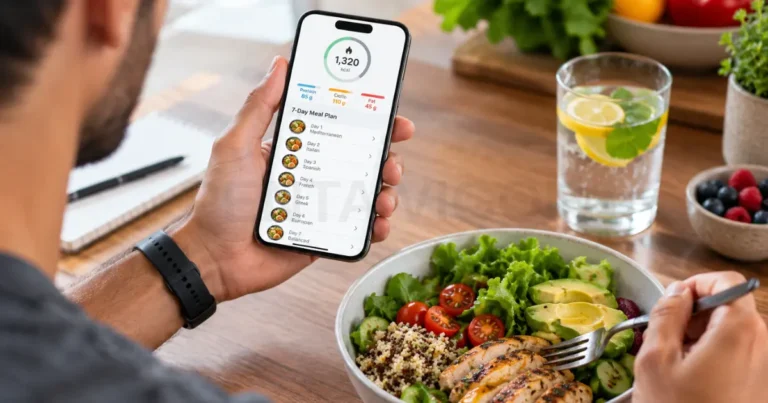
Have you ever asked yourself, how many calories should I eat a day, and found answers that range from 1,200 to 3,000? There is no single correct number, because your needs depend on your body size, age, sex, and daily activity. In this guide, we explain the European reference values, show why your own requirement may differ from an average, and describe when a calorie target should be set with a health professional.
The Short Answer for European Adults
Most healthy European adults need roughly 1,800 to 2,600 kilocalories (kcal) a day to keep their weight stable. The exact figure depends mainly on body size and activity. For a moderately active adult, the European Food Safety Authority (EFSA) gives about 2,000 to 2,600 kcal in the 30s, 2,000 to 2,500 kcal in the 50s, and 1,800 to 2,300 kcal in the 70s. Women usually sit toward the lower end of each range and men toward the upper end.
A calorie on a food label is really a kilocalorie, and 1 kcal equals about 4.2 kilojoules (kJ). The German Nutrition Society (DGE) offers a concrete example. Women aged 25 to 50 with a mostly sedentary life need about 1,800 kcal, while very active women need about 2,400 kcal. For men of the same age, the DGE figures are about 2,300 and 3,000 kcal.
These numbers describe groups, not individuals. The Health Council of the Netherlands states that an average energy requirement is not suitable for applying to one person, because requirements vary widely between people. When you ask how many calories should I eat a day, treat the figures as a sensible starting range that you refine with your own weight, appetite, and energy over several weeks. Next, we look at how EFSA builds its age-based values.
EFSA average requirements for women and men by age band
EFSA publishes average requirements (ARs) for energy, which estimate what a healthy population group needs to maintain body weight. The panel multiplied estimated resting energy expenditure, calculated with the Henry (2005) equations, by physical activity level (PAL) values of 1.4, 1.6, 1.8, and 2.0. It assumed a healthy body mass index (BMI) of 22 and used adult heights measured in national surveys in 13 EU member states.
Age band | Average requirement, moderately active | How to read it |
30 to 39 years | 2,000 to 2,600 kcal per day | Lower end typical for women, upper end for men |
50 to 59 years | 2,000 to 2,500 kcal per day | Similar spread, with a slightly lower upper end |
70 to 79 years | 1,800 to 2,300 kcal per day | Both ends lower as body mass and activity decline |
The ranges fall gently with age. The upper limit drops by about 300 kcal between the 30s and the 70s, and the lower limit drops by about 200 kcal. Just as important, each range is 500 to 600 kcal wide, which shows how much real adults differ in size, sex, and movement even within one age group.
EFSA stresses that these values should be adjusted for people whose BMI is above or below 22 and for different lifestyles. They describe the energy needed to maintain body mass, not a weight-loss target. For that reason, we use them as reference points throughout this guide rather than as prescriptions.
Why the 2,000 kcal on your packaging is a labeling value
The 2,000 kcal figure on food packaging is a reference intake for labeling, not a personal recommendation. Under Regulation (EU) No 1169/2011, Annex XIII sets the reference intake of an average adult at 8,400 kJ or 2,000 kcal. Where a pack shows percentages of reference intakes, it must include a statement that they refer to an average adult (8400 kJ/2000 kcal).
The same idea applies in the United States. The U.S. Food and Drug Administration (FDA) says 2,000 calories a day is used as a general guide for nutrition advice on the Nutrition Facts label, and that your needs may be higher or lower. The Dietary Guidelines for Americans 2025-2030, released in January 2026, also continue to illustrate their food-group advice with a 2,000-calorie pattern.
We suggest treating the label value as a shared yardstick that helps you compare products, much like a standard test used to compare fuel economy across cars. Your own daily energy need may sit several hundred kcal above or below it. To see what shapes that difference, we turn to the factors that move your requirement up or down.
What Moves Your Personal Requirement Up or Down
Your daily energy requirement is the total of what your body spends on basic functions, on digesting food, and on movement. Researchers call this total energy expenditure. Resting metabolism usually makes up the largest share, which is why body size and composition matter so much. Activity is the part you can change most easily, and it is one reason how many calories you should consume each day differs so much between people.
Five factors explain most of the difference between one adult and another, and we look at each in turn in the sections below. Some, such as body size and age, are fixed or change slowly. Others, such as activity, are partly under your control. Understanding them helps you judge how far to trust any single number you read online.
- Body size and fat-free mass (muscle, organs, bone, and water)
- Age, especially after about 60
- Sex, largely through differences in body composition
- Physical activity, including work, household tasks, and exercise
- Individual metabolic variation that we cannot yet predict well
Situations such as pregnancy, breastfeeding, illness, and recovery add temporary changes, which we cover later in this guide. These changes can matter a great deal for your health, so they deserve separate attention. We begin with the factor that matters most for adults under 60, which is body size and fat-free mass.
Body size and fat-free mass as the primary drivers
Body size, and especially fat-free mass, is the strongest single predictor of how much energy you use each day. Fat-free mass includes muscle, organs, bone, and body water. In a large 2021 analysis of more than 6,400 people measured with the doubly labeled water method, total energy expenditure rose with fat-free mass in a power-law pattern, meaning it increases with size but not in a simple straight line.
This explains why two adults of the same age can need noticeably different amounts of food. A taller, more muscular person uses more energy at rest than a smaller person with less muscle, even before any exercise. Fat mass also adds to expenditure, but it contributes less per kilogram than fat-free mass.
EFSA’s values assume a BMI of 22, and the Nordic Nutrition Recommendations 2023 assume a BMI of 23 for adults. If you are much larger or smaller than these reference bodies, your requirement will move in the same direction as your size. Keeping or building muscle through strength training and regular movement can help protect your energy needs across adult life.
The gradual decline in requirement after 40
Reference tables show energy requirements easing down gradually from midlife, and measured data suggest the picture is more nuanced. EFSA’s ranges fall from the 30s to the 70s. However, the 2021 Science analysis of doubly labeled water data found that expenditure adjusted for fat-free mass stayed stable from about age 20 to 60, and then declined by roughly 0.7 percent per year.
A 2026 cross-sectional study of 2,326 adults from research centers in nine European countries and the United States gives a practical sense of scale. Women aged 55 to 70 had about 217 kcal a day lower expenditure than women aged 30 to 39, and men aged 55 to 70 had about 334 kcal a day lower. Men aged 40 to 54 were already about 124 kcal a day lower than men in their 30s.
Less muscle, lower daily activity, and slower cell-level metabolism may all contribute. The practical message is not to cut calories automatically as birthdays pass. Staying active and keeping muscle can protect your requirement, and the Nordic Nutrition Recommendations 2023 identify frail older adults as a group at risk of low energy intake.
Sex differences and body composition, not sex alone
On average, women need fewer calories than men mainly because they tend to be smaller and to carry less fat-free mass, not because of sex itself. The reference values reflect this gap. In the German DGE figures for ages 25 to 50 with low activity (PAL 1.4), the estimate is about 1,800 kcal for women and about 2,300 kcal for men.
When researchers adjust for body composition, the gap largely disappears. Large doubly labeled water datasets, including the 2021 Science analysis and the 2026 European and U.S. study, report similar adjusted expenditure in women and men. A tall, muscular woman may therefore need more energy than a small, lightly built man.
Menopause brings a shift in body composition, with more fat mass and faster loss of fat-free mass, rather than a large change in adjusted energy expenditure. For women and men alike, protecting muscle through strength training and adequate protein is more useful than focusing on sex-based calorie rules. The next factor is even harder to predict, and that is natural variation between individuals.
Genetic and inter-individual variability in requirement
Even after accounting for age, sex, fat-free mass, and fat mass, daily energy expenditure still varies considerably from one person to the next. Doubly labeled water studies show that this variation is hard to predict from general equations. Repeated measurements in adults also show that expenditure is fairly repeatable within a person, which suggests that part of the difference is a stable personal trait. Possible contributors include genetics, organ size, and hormones.
For you, this means any calculator is an estimate, including ours [insert internal link to the Penta Vigor calorie calculator]. The Health Council of the Netherlands notes that prediction equations can underestimate or overestimate a personal requirement, and it recommends monitoring body weight as a check. We suggest the following five-step approach, which is meant to be gentle and flexible.
- Start with a reference estimate for your age, sex, and activity level.
- Eat in a consistent, balanced pattern for several weeks.
- If you choose to weigh yourself, do so at the same time of day and look at the trend rather than single readings.
- If your weight is stable and your energy, sleep, and mood are good, your intake is probably matching your needs.
- If your weight drifts steadily in a direction you did not intend, make small adjustments and recheck, and speak with a clinician if changes are large or unexplained.
If weighing yourself or tracking food makes you anxious, please skip this check and talk with a clinician instead, because your wellbeing matters more than any number. With personal variation in mind, we can now look at how daily activity changes the picture.
Daily Calories by Physical Activity Level
Physical activity level (PAL) is the ratio of your total daily energy expenditure to your resting energy expenditure, and it is the simplest way to adjust a reference value for your lifestyle. EFSA uses PAL values of 1.4, 1.6, 1.8, and 2.0 to approximate low active, moderately active, active, and very active lifestyles. A higher PAL multiplies the same resting need into a higher daily requirement.
The effect is large. In the DGE figures for adults aged 25 to 50, moving from PAL 1.4 to PAL 1.8 raises the estimated requirement from about 1,800 to 2,400 kcal for women and from about 2,300 to 3,000 kcal for men. That is an extra 600 to 700 kcal a day from lifestyle alone. The next three sections show what each level can look like in real life.
Desk-based and largely sedentary lives
A desk-based life usually falls at a PAL of about 1.4 to 1.6, which means a lower requirement than a physically active day but far above the very low targets often quoted online. The DGE classifies seated office work with little leisure activity at 1.4 to 1.5. It classifies seated work with some standing or walking, such as laboratory work, driving, or studying, at 1.6 to 1.7.
Consider an office worker who commutes by car, sits through most meetings, and relaxes on the sofa in the evening. She is likely closer to 1.4. If she adds a brisk 30-minute walk on most days and cycles at weekends, she moves toward 1.6. The same job, with a different evening, changes her requirement by several hundred kcal.
You may sit closer to the lower end of this band when most of the points below describe your week, and closer to the upper end when several do not. This is a rough guide rather than a test, and honest self-assessment works better than optimism.
- Your job is mostly seated
- Your commute involves little walking or cycling
- You do little structured exercise
- Your leisure time is mostly seated
- You rarely climb stairs or walk for errands
Standing, manual, care and shift work
Jobs that keep you on your feet typically sit at a PAL of about 1.8 to 1.9, and physically demanding work can reach 2.0 to 2.4. The DGE places sales staff, waiters, mechanics, and skilled tradespeople in the 1.8 to 1.9 band. Construction workers, farmers, forestry workers, and competitive athletes are placed at 2.0 to 2.4. Care work that combines walking, lifting, and standing through a whole shift likely resembles the first group.
Shift work changes when people eat more clearly than how much they need. A 2023 systematic review and meta-analysis found that rotating shift workers ate about 264 kJ (roughly 63 kcal) more per day than day workers, with more irregular meals, more snacking, and more eating at night. A separate review found no detectable difference in energy intake between night shifts and other shift patterns.
If you work shifts or physically demanding hours, plan meals around your schedule rather than around the clock. Preparing balanced food in advance can make it easier to eat regularly when appetite and opportunity do not line up. Next, we turn to people who train regularly.
Recreational and competitive athletes
Athletes and very active people can reach a PAL of 2.0 or more, which raises the daily requirement substantially above the values for typical adults. EFSA uses 2.0 for very active lifestyles, and the DGE lists competitive athletes in its 2.0 to 2.4 band. Recreational exercisers often sit lower than they expect, because a few sessions a week raise the weekly average only modestly.
The larger risk for active people is usually eating too little, not too much. The 2023 International Olympic Committee (IOC) consensus statement describes Relative Energy Deficiency in Sport (REDs) as the harmful effects of low energy availability, meaning too little energy left after training to support normal body functions. It affects female and male athletes, and the statement describes low energy availability as a spectrum from adaptable to problematic.
Energy availability is calculated as energy intake minus exercise energy expenditure, divided by fat-free mass. Research has often used about 30 kcal per kilogram of fat-free mass per day as a reference point for low energy availability. If you train hard, a sports dietitian can help you plan intake around your training load. We now step back from individual factors to compare how European countries publish their figures.
How Guidance Differs Across European Countries
There is no single national calorie figure across Europe, because EFSA publishes EU-level reference values and national bodies adapt them to local populations and purposes. Some countries publish tables by age and activity, while others publish one simple figure for public messages. The differences look confusing at first, but they usually reflect method rather than disagreement.
When you compare two sets of numbers, the questions below explain most of the gap between sources. Each one can shift a published figure noticeably without either source being wrong. We compare the main European and American sources in the next section, and then explain why they diverge.
- Which reference body weight and height does the source assume?
- Which PAL or activity level does the figure describe?
- Is it a group average or a simplified public message?
- Is it listed in kcal, kJ, or MJ?
- Which age band does it cover?
DGE, ANSES, Nordic Nutrition Recommendations and NHS figures compared
The main European sources give adult figures that cluster around 1,800 to 2,400 kcal for women and 2,300 to 3,000 kcal for men, depending on age and activity. The table below sets them side by side, with the United States for context. Units are converted to kcal, where 1 MJ equals about 239 kcal.
Source | Adult figures | Basis andnotes |
EFSA (European Union) | 2,000 to 2,600 kcal (ages 30 to 39); 2,000 to 2,500 kcal (ages 50 to 59) | Moderately active (PAL 1.6), BMI 22, group average |
NHS (United Kingdom) | About 2,000 kcal for women and 2,500 kcal for men | Simplified public message (8,400 and 10,500 kJ) |
DGE (Germany) | Ages 25 to 50: women 1,800 to 2,400 kcal; men 2,300 to 3,000 kcal | PAL 1.4 to 1.8 |
ANSES (France), as commonly reported | Ages 20 to 40: about 2,200 kcal women, 2,700 kcal men. Ages 40 to 60: about 2,000 kcal women, 2,500 kcal men | Adjusted by activity level; traces to earlier French recommended intakes |
Nordic Nutrition Recommendations 2023 | About 2,150 kcal for women (9 MJ); about 2,700 kcal for men (11.3 MJ) | PAL 1.6, BMI 23 |
United States (Dietary Guidelines) | About 1,600 to 2,400 kcal for women; 2,000 to 3,000 kcal for men | Range across ages and activity levels; label reference is 2,000 kcal |
Read the table as a map of ranges, not a contest. A woman in her 40s with a moderately active life lands near 2,000 to 2,200 kcal in almost every source, and a man in the same situation lands near 2,500 to 2,700 kcal. For France, we cite the values most often reported for ANSES, so please check current ANSES publications if you need formal figures for clinical or regulatory use.
Why national figures diverge from EFSA reference values
National figures diverge mainly because each body chooses its own reference body size, activity assumption, and purpose. EFSA assumes a BMI of 22, while the Nordic Nutrition Recommendations 2023 calculate adult reference weights from a BMI of 23 using recent Nordic and Baltic heights. The Health Council of the Netherlands adopted EFSA’s approach in 2022 but used different reference weights, because the average Dutch adult is taller.
Purpose matters as well. A national health service may publish one rounded figure for public messages, such as the NHS figures of 2,000 and 2,500 kcal, while scientific committees publish tables for population planning. The Nordic recommendations present values for a single PAL of 1.6, whereas EFSA and the DGE show several PAL values.
These differences are normally well within the natural variation between individuals that we described earlier. If two sources disagree by a couple of hundred kcal, you do not need to choose a winner. Next, we look at the other end of the scale, where intake is too low to be safe without supervision.
Minimum Intakes and Why Floors Exist
There is no single minimum calorie number that is safe for every adult, but floors exist because the body cannot meet its essential nutrient needs on very little food. Anyone asking how many kilocalories should I eat a day is really asking about a range with a ceiling and a floor. In its 2015 opinion on total diet replacements for weight control, EFSA proposed a minimum of 600 kcal a day for specially formulated products designed for adults with overweight or obesity.
That figure was derived from minimum amounts of protein, carbohydrate, and essential fats, and it does not apply to the general public. EU law also sets labeling categories. Under Commission Delegated Regulation (EU) 2017/1798, such products may be called very low calorie diets when they provide less than 800 kcal a day, and low calorie diets when they provide 800 to 1,200 kcal a day. These are product categories, not personal safety thresholds.
Very-low-energy diets and the supervision requirement
A very low energy diet (VLED), usually about 800 kcal a day or fewer, should be followed only under medical supervision. The NHS describes it as a clinically supervised plan for adults with obesity (BMI over 30) or severe obesity (BMI over 40) who need to lose weight quickly. It is not a first option, it should not be used routinely, and it should last no longer than 12 weeks.
U.S. guidelines from the American Heart Association, the American College of Cardiology, and The Obesity Society likewise advise that these diets be used only in limited circumstances and delivered by trained professionals with medical monitoring. The NHS also notes that weight often returns after the diet ends. The two lists below summarize who it is not suitable for and what side effects are common.
The NHS says a VLED is not suitable if you are:
- Under 18
- Pregnant
- Breastfeeding
- Someone who has had an eating disorder
Common side effects listed by the NHS:
- Feeling hungry or low on energy
- Dry mouth
- Constipation or diarrhea
- Headaches and dizziness
- Cramps
- Hair thinning
Physical signs you are chronically under-eating
Chronic under-eating can show up as a cluster of physical and emotional signs that reflect low energy availability. The IOC’s 2023 statement uses the term REDs, which replaced the earlier acronym RED-S, and describes effects on menstrual function, bone health, the digestive system, and mental health. Research is strongest in athletes, but the underlying problem, too little energy for the body’s needs, is not unique to sport.
Signs worth taking seriously, especially when several occur together:
- Persistent tiredness or low energy that sleep does not fix
- Feeling cold much of the time
- Irregular, light, or missing periods (amenorrhea) in people who menstruate
- Loss of sex drive
- Frequent colds or infections and slow recovery
- Stress fractures or repeated bone and tendon injuries
- Dizziness, especially when standing up
- Constipation, bloating, or other digestive changes
- Hair thinning or hair loss
- Trouble concentrating, low mood, or irritability
- Constant preoccupation with food or fear of eating
These symptoms have many possible causes, so they are a reason to seek medical advice rather than a diagnosis. A doctor can check for other conditions and, where needed, involve a dietitian or mental health professional. If you recognize several of these signs, please arrange an appointment soon rather than waiting for them to pass.
Eating enough energy is only part of eating well. A diet can meet your calorie needs and still fall short on key nutrients. The next section looks at why the quality of those calories matters just as much as the quantity.
Calories Are Not the Same as Nutritional Adequacy
Two diets with the same calorie count can differ enormously in the vitamins, minerals, fiber, and protein they provide. Nutrient density describes how many of those essential nutrients you get for each calorie. A 250 kcal slice of sugary pastry and a 250 kcal bowl of lentil and vegetable soup with olive oil cost your energy budget the same, yet only the soup delivers meaningful fiber, iron, and potassium.
This matters more as the budget gets smaller. When your target sits near 2,000 kcal, there is room for some foods that are mostly energy. When it sits much lower, nearly every food needs to earn its place. We look at how to manage that in the next two sections.
Meeting micronutrient needs inside a smaller energy budget
Meeting micronutrient needs on a lower energy intake is possible, but it takes planning and gets harder the lower you go. EFSA’s population reference intake for iron is 11 mg a day for men and postmenopausal women, and 16 mg a day for premenopausal women because of menstrual losses. Premenopausal women who eat little may therefore be among those most likely to fall short.
A nutrient-dense pattern usually draws on the food groups below, in amounts that suit your appetite, culture, and budget. No single food is essential, and variety is what protects you from gaps. People who eat a plant-based diet may need extra attention to iron, vitamin B12, and iodine.
- Vegetables and fruit in a range of colors
- Whole grains and other fiber-rich starchy foods
- Beans, lentils, and peas
- Fish, including oily fish
- Eggs, lean meat, dairy, or fortified plant alternatives
- Nuts, seeds, and unsaturated oils such as olive or rapeseed oil
Vitamin D deserves a special mention in northern Europe, where winter sunlight is limited. EFSA set an adequate intake rather than a population reference intake, because vitamin D status depends on both sun exposure and diet. If you eat well below your needs for a long time, or follow a restrictive pattern, ask your doctor whether blood tests or supplements are appropriate.
Protein, fiber and essential fat minimums
EFSA sets the population reference intake for protein at 0.83 g per kilogram of body weight per day for all adults, including older adults. For a 70 kg adult, that is about 58 g a day. EFSA also notes that intakes of around twice this level are regularly eaten by some physically active, healthy adults in Europe and are considered safe.
Beyond protein, EFSA’s reference values give other targets that help you judge whether your intake is adequate, whatever your calorie level. They are expressed as shares of energy or as daily amounts, and they apply to healthy adults. Use them as a guide for food choices rather than as numbers to track obsessively.
- Protein: 0.83 g per kg of body weight per day
- Dietary fiber: 25 g per day supports normal bowel function
- Total fat: 20 to 35 percent of energy
- Carbohydrate: 45 to 60 percent of energy
- Essential fats: linoleic acid at 4 percent of energy and alpha-linolenic acid at 0.5 percent of energy
The EU label reference intake for protein is 50 g, a rounded figure for an average adult. Older adults and people recovering from illness may need more, which we discuss in the next section. Eating enough protein and fiber can also help you feel satisfied on any calorie level, and it keeps your diet steady when life changes.
Adjusting Your Intake When Circumstances Change
Your energy needs are not fixed, and they shift with body weight, health, and stage of life. When a person loses weight, the requirement falls because a smaller body uses less energy, which is one reason progress can plateau. During pregnancy, EFSA estimates additional needs of about 70, 260, and 500 kcal a day in the first, second, and third trimesters, and about 500 kcal a day for women who exclusively breastfeed in the first six months.
These are population estimates, and individual needs during pregnancy and breastfeeding vary, so your prenatal or postnatal care team should guide you. The Health Council of the Netherlands, for example, used slightly different assumptions for both stages in its 2022 report. Illness and injury can change needs too, as we explain next.
Illness, surgery, injury and reduced mobility
Illness, surgery, and injury can raise or lower energy needs, and they often reduce appetite at the same time. Fever and healing increase the body’s demands, while bed rest and reduced mobility lower activity. The result is that some people eat too little when they need more, which can slow recovery.
Clinical teams use weight-based estimates that are adjusted to the individual. The European Society for Clinical Nutrition and Metabolism (ESPEN) gives a guiding value of 30 kcal per kg per day for older persons, with at least 1 g of protein per kg. For surgical patients, ESPEN has cited about 25 to 30 kcal per kg of ideal body weight. In the first days of critical illness, it advises giving less than the full estimated need and increasing gradually, partly to limit the risk of overfeeding and refeeding syndrome.
These figures are written for clinical teams and are not meant for self-treatment at home, because the right amount depends on your illness, treatment, and stage of recovery. Please ask your doctor or a dietitian for guidance if any of the following apply during illness or recovery.
- You are losing weight without trying
- You are eating much less than usual for a week or more
- Chewing, swallowing, nausea, or pain makes eating difficult
- You have a wound, pressure sore, or fracture that is slow to heal
- You are restarting regular food after a long period of very little intake
Nutrition support in hospital is planned around your clinical team’s assessment, not around a fixed calorie number, and it is reviewed as you recover. Some other situations also call for professional guidance from the very start, and we describe them in the next section.
Who Should Not Set Their Own Calorie Target
Some people should not set a calorie target on their own and should work with a doctor or registered dietitian instead. This is not a judgment about willpower or knowledge. It reflects situations in which an energy number can be unsafe, misleading, or harmful to your relationship with food. Please seek professional guidance first if any of the points below apply to you.
- You have a current or past eating disorder, or you fear that counting calories could trigger one
- You are pregnant, trying to conceive, or breastfeeding
- You are under 18, because your body is still growing
- You live with a chronic condition such as diabetes, kidney disease, heart failure, cancer, or a digestive disorder
- You take medicines that can change appetite or weight
- You are underweight, or you are losing weight without trying
- You are a frail older adult or have difficulty chewing or swallowing
- You have had weight-loss surgery
Medicines authorized in the European Union, including those assessed by the European Medicines Agency (EMA), come with patient information that lists effects on appetite or weight where relevant. If you are unsure, your pharmacist can review your medicines with you and explain what to watch for. You never need to manage these questions alone.
If thinking about food and numbers feels overwhelming or hard to stop, help is available and recovery is possible. In the United States, the National Alliance for Eating Disorders runs a helpline. In the United Kingdom, Beat offers support, and most European countries have a national eating disorder association that your doctor can point you to. You do not need to wait until things feel serious to ask for help.
Daily Calorie Questions Readers Ask
Is eating 1,200 kcal a day safe for an adult?
For most healthy adults, 1,200 kcal a day is well below estimated needs and is not a safe default target. EFSA’s ranges for moderately active adults are roughly 1,800 to 2,600 kcal, so 1,200 kcal represents a large shortfall. In EU law, 800 to 1,200 kcal describes the low calorie diet category for specially formulated total diet replacement products, which are intended for adults with overweight or obesity.
Nutrient adequacy also becomes difficult at this level, particularly for iron, calcium, and protein. The lowest figures for adult women in the U.S. Dietary Guidelines tables are still about 1,600 kcal. If you are considering a very low intake, please speak with your doctor or a dietitian first.
Do I need more calories in cold weather?
Usually only a little, and most people do not need to change their target for the weather. A UK government rapid evidence summary found that studies of cooler air, typically 16 to 20 degrees Celsius, reported increases in energy expenditure of about 50 to 200 kcal a day, with wide variation. A controlled study of normally clothed adults found 24-hour expenditure about 5 percent higher at 20 degrees Celsius than at 28 degrees Celsius.
In a small laboratory study, mild cold did not increase hunger or food intake, so appetite does not always compensate. You might need more energy if you work outdoors in winter, train outside, or live in a cold home. For most people, your activity level matters more than the thermometer.
Does eating late at night change my requirement?
Not your basic requirement, but the timing of meals can change hunger and how your body handles food. In a 2022 controlled laboratory study in Cell Metabolism, 16 adults with overweight or obesity ate identical meals on two schedules, one four hours later than the other. Late eating increased hunger, lowered the hormone leptin, slowed the calories burned after eating, and altered gene activity in fat tissue.
The study was small and tightly controlled, and in everyday life late eating often travels with snacking, poor sleep, and irregular routines. If you are hungry in the evening, it may help to eat a balanced meal earlier and include protein and fiber during the day. An occasional late dinner is not a problem for most people.
So, how many calories should I eat a day? For most healthy adults in Europe, EFSA’s reference values point to roughly 1,800 to 2,600 kcal, shaped by body size, age, sex, and activity, and illness, pregnancy, and life changes can shift that number. Use the reference ranges as a starting point, protect the quality of your food, and avoid very low intakes without supervision. If you have a question we have not covered, tell us and we will consider it for our next update.