Are you looking for work out exercises that are effective, safe, and realistic for your week? With thousands of options online, it is easy to feel unsure which movements truly deserve your time. In this guide, we organize the best exercises by muscle group, explain the evidence behind them, and show you how to build a balanced session you can repeat with confidence.
How to Use This Exercise Library by Muscle Group
Work out exercises are most useful when you can find them by muscle group and fit them into a realistic week. This library names the key movements for each muscle group, explains what they do, and points out where the evidence is strong or still limited. Use it as a menu: choose one or two options per muscle group, then use the later sections to assemble a session so that each exercise workout you plan has a clear purpose.
Most adults still have room to start. In the 2022 Eurobarometer survey, 45% of EU respondents said they never exercise or play sport, and in the United States only 31.0% of adults met the muscle-strengthening guideline in 2020. The World Health Organization (WHO) recommends muscle-strengthening on 2 or more days per week, involving all major muscle groups.
Compound vs Isolation Workout Exercises
Compound exercises train several joints and muscle groups at once, while isolation exercises train one joint and mainly one muscle group. A squat works your hips, knees, and ankles together, whereas a biceps curl moves only the elbow. Both are useful workout exercises, but they play different roles in a balanced program.
Compound lifts usually deserve the first place in your session. They let you move heavier loads, train more muscle in less time, and match everyday tasks such as standing up or carrying groceries. Isolation work then targets muscles that compound lifts can leave under-trained, such as the calves, hamstrings, or rear shoulders.
Use this checklist to decide which type you need:
- Choose compound lifts when time is short or when you are a beginner.
- Add isolation exercises when a muscle lags behind or when you need to train around an injury.
- Place compound lifts early in your session, while you are fresh, as the 2026 ACSM review recommends for strength work.
- Keep most isolation exercises for the end of the workout.
Movement Patterns vs Muscle Groups: Two Ways to Organize Training
Muscle-group training sorts exercises by the muscle you want to develop, while movement-pattern training sorts them by the action your body performs. Both approaches work, and many people blend them. The right choice depends on your goal, your schedule, and how you like to plan your week.
A muscle-group approach is easy to follow, for example chest and back on one day and legs on another. A movement-pattern approach groups lifts into pushes, pulls, squats, hinges, and carries. Because a bench press and a shoulder press both push, they share a session, even though they train slightly different muscles.
The 2026 American College of Sports Medicine (ACSM) position stand stresses that training every major muscle group at least twice a week matters more than the exact split (Currier et al., 2026). In other words, the best structure is the one you will actually follow.
Choose muscle-group training if you:
- Prefer a clear weekly structure, such as upper-body and lower-body days.
- Want to give extra attention to one specific muscle group.
Choose movement-pattern training if you:
- Have limited time and prefer full-body sessions.
- Want exercises that carry over to daily life and sport.
Now that you know how exercises are classified and organized, we can move from principles to practice. In the next section, we look at specific movements for each muscle group, beginning with the lower body, where the largest muscles in your body are found.
Best Workout Exercises for the Lower Body
The lower body holds the largest muscles you have, so training it delivers a large return for your effort. Your quadriceps, hamstrings, glutes, and calves work together when you stand, walk, climb stairs, or rise from a chair. Strong legs also support balance and independence as you age, and most people benefit from training them at least twice per week, in line with the general advice to work every major muscle group on 2 or more days. We start with the muscles on the front of your thigh.
Quadriceps: Squats, Leg Press and Lunges
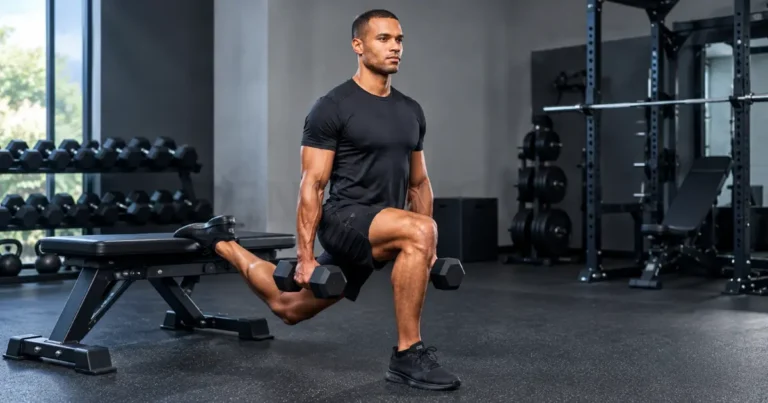
The quadriceps are the four-headed muscle group on the front of your thigh, and they extend your knee. Squats, leg presses, and lunges are three of the most practical ways to train them. All three also involve your glutes and inner thigh muscles, so they count as compound exercises.
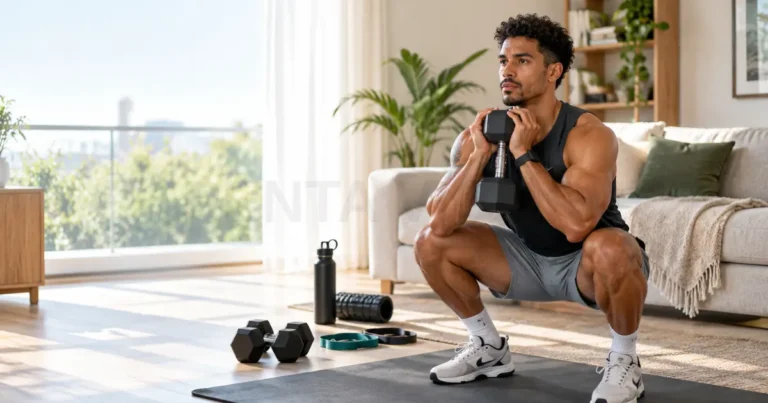
A goblet squat, held at your chest with a dumbbell or kettlebell, is a friendly starting point. The leg press offers back support and easy loading, which suits beginners and older adults. Lunges and split squats add a balance demand and train one leg at a time, which can reveal strength differences between sides.
Technique checklist for squats and lunges:
- Keep your whole foot on the floor and your knees tracking in line with your toes.
- Use the full range of motion you can control without pain, since the ACSM review favors full range.
- Keep your chest tall and your trunk braced.
- Start with a load you can lift for 10 to 12 controlled repetitions.
Hamstrings: Romanian Deadlifts and Leg Curls
The hamstrings are the three muscles at the back of your thigh that bend your knee and help extend your hip. Romanian deadlifts train them through the hip, and leg curls train them through the knee. Using both gives the most complete coverage.
In a 12-week trial of 20 adults, seated leg curls produced more hamstring growth than lying leg curls (about 14% versus 9%), likely because the muscles were trained in a more stretched position (Maeo et al., 2021). This was one small study in young adults, so treat it as a helpful tip rather than a rule. Either curl is effective when performed through a full range of motion.
Romanian deadlift cues:
- Push your hips back as if closing a car door with them, keeping a soft bend in the knees.
- Keep the bar or dumbbells close to your legs.
- Lower until you feel a stretch behind your thighs, and stop before your back rounds.
Glutes: Hip Thrusts and Step-Ups
The gluteal muscles, led by the gluteus maximus, extend your hip and help stabilize your pelvis when you walk, climb, and lift. Hip thrusts and step-ups are two popular ways to train them, and squats and deadlifts also work them hard.
In a 9-week randomized trial of 34 untrained adults, hip thrusts and back squats produced similar glute growth when the total sets were matched (Plotkin et al., 2023). Hip thrusts showed higher glute activity on electromyography, yet this did not reliably predict growth. How strongly you feel a muscle working is therefore not the best guide to results.
Step-ups add a single-leg challenge that suits home training. Use a sturdy box or bench at about knee height, and drive through the heel of the working leg. Hold dumbbells at your sides to progress, and step down slowly rather than dropping, so the working leg controls the whole movement.
Hip thrust checklist:
- Rest your upper back on a stable bench with your feet flat and about hip-width apart.
- Drive through your heels until your hips and torso form a straight line.
- Pause briefly at the top, then lower with control.
Calves: Standing and Seated Calf Raises
The calves are made of two main muscles, the gastrocnemius and the soleus, which lift your heel when you walk, run, or jump. The gastrocnemius crosses the knee, so it works best with a straight leg. The soleus sits deeper and is trained well with a bent knee.
In a 2023 study of 14 untrained adults, standing calf raises produced far more gastrocnemius growth than seated raises, while soleus growth was similar with both (Kinoshita et al., 2023). Calves tend to respond slowly, so patience and steady progression help.
For most people, a standing calf raise on a step, performed through a full stretch and a full rise, covers the basics. Add a seated version if you want extra soleus work. Keep your knee straight but not locked, and let your heel drop below the step so the muscle is stretched under load.
Calf raise checklist:
- Pause for one second at the bottom stretch and at the top.
- Use a slow, controlled tempo rather than bouncing.
- Progress by adding repetitions first, then weight.
With your lower body covered, you now have a strong foundation for standing, walking, and lifting. Next, we turn to the muscles above the waist, starting with the chest, back, and shoulders, and see how pressing and pulling exercises work together to build a balanced upper body.
Best Workout Exercises for the Upper Body
Upper-body training builds the muscles that push, pull, lift, and carry in daily life. Your chest, back, shoulders, and arms work as a team, so balance matters, and many coaches suggest including similar amounts of pressing and pulling across the week. If your equipment is limited, push-ups, band rows, and dumbbell presses cover most needs. We begin with the chest.
Chest: Presses, Flyes and Dips
The chest muscles, mainly the pectoralis major, bring your arms forward and across your body. Presses are the foundation, flyes isolate the chest, and dips combine chest and triceps work. Push-ups, bench presses, and dumbbell presses all belong to the press family.
A push-up needs no equipment and scales easily: raise your hands on a bench to make it easier, or elevate your feet to make it harder. Dumbbell presses let each arm work independently. Cable or dumbbell flyes can finish the session by stretching the chest under light load.
Dips are demanding on the shoulders, so we suggest them only once you can press comfortably and without shoulder pain. Stop any chest exercise if you feel a sharp pinch at the front of the shoulder. A close-grip push-up or a machine press is a more comfortable alternative for many people.
Push-up checklist:
- Place your hands slightly wider than your shoulders, with your body in a straight line.
- Keep your elbows at about 45 degrees from your trunk rather than flared straight out.
- Lower until your chest is close to the floor, then press back up.
Back: Pull-Ups, Rows and Pulldowns
The back is a large group of muscles, including the latissimus dorsi, rhomboids, and trapezius, that pull your arms and shoulder blades toward your body. Pull-ups, rows, and pulldowns are the main exercises. Together they support better posture, which is helpful if you sit for long periods.
Pull-ups are hard for most beginners. A lat pulldown or a band-assisted pull-up lets you practice the same movement with adjustable help. Rows, whether with dumbbells, cables, or a machine, train the mid-back and add variety to your pulling angles.
Pull with your elbows rather than your hands, and avoid swinging your trunk to finish a repetition. If your grip fades before your back does, a lighter weight or lifting straps can help, and we return to grip training later in this guide.
Pulling checklist:
- Start each repetition by drawing your shoulder blades down and back.
- Lead with your elbows and keep your wrists neutral.
- Lower the weight slowly rather than letting it drop.
Shoulders: Overhead Press and Raises
The shoulder muscles, called the deltoids, have three parts that raise your arm forward, to the side, and backward. The overhead press trains the front and side parts together. Lateral raises isolate the side part, while rear-delt raises and face pulls train the back part.
Seated dumbbell presses are a good starting point because the backrest steadies your trunk. Press with your forearms vertical and finish with your arms close to straight above your shoulders. Light lateral raises with controlled movement usually work better than heavy, swinging ones.
Shoulder discomfort is common among people who lift. If you feel pinching, reduce the range slightly, lower the load, and consider having a physical therapist review your technique. Persistent shoulder pain needs a professional assessment. Small adjustments, such as changing your grip width or using dumbbells instead of a barbell, often make presses more comfortable.
Shoulder-friendly habits:
- Warm up with light band pull-aparts or gentle arm circles.
- Keep your ribs down so your lower back does not arch during presses.
- Use a weight you can control for every repetition.
Arms: Curls, Extensions and Carries
The biceps bend your elbow and the triceps straighten it, so you need both curls and extensions to train the arms fully. Overhead triceps extensions deserve a place in your plan: in a 12-week study of 21 adults, triceps growth was substantially greater with overhead cable extensions than with pushdowns (Maeo et al., 2022). Farmer’s carries also train both muscles and your grip.
Forearms and Grip: The Overlooked Link
Grip strength is the force you can produce when squeezing with your hand, and it reflects the condition of your forearm muscles. In the PURE study of 139,691 adults aged 35 to 70, every 5 kg (11 lb) drop in grip strength was associated with a 16% higher risk of death from any cause (Leong et al., 2015). This shows an association, not proof that training grip changes risk, but it explains why grip deserves attention.
Simple ways to train grip:
- Farmer’s carries with heavy dumbbells or kettlebells.
- Short dead hangs from a pull-up bar.
- Wrist curls and reverse curls with light weights.
Strong arms and shoulders are only half the story, because every lift also depends on a stable trunk. Whether you press, pull, squat, or carry, your core transfers force between your upper and lower body. Next, we look at how to train it properly, beyond crunches and sit-ups.
Best Core Exercises for Stability and Strength
Your core is the group of muscles around your trunk, including the abdominals, obliques, deep spinal stabilizers, and hip muscles, and its main job is to keep your spine steady. Sit-ups are not the only answer. Modern programs train the core to resist unwanted movement while your arms and legs work. The next section explains the three categories that cover almost every core exercise.
Anti-Extension, Anti-Rotation and Anti-Lateral Flexion Explained
Core exercises fall into three stability categories: anti-extension (resisting arching of the lower back), anti-rotation (resisting twisting), and anti-lateral flexion (resisting side-bending). Training all three gives a more complete result than crunches alone. Spine researcher Stuart McGill popularized this approach through the modified curl-up, side bridge, and bird dog (McGill and Karpowicz, 2009).
Examples for each category:
- Anti-extension: front plank, dead bug, and (for advanced trainees) ab wheel rollout.
- Anti-rotation: Pallof press and bird dog.
- Anti-lateral flexion: side plank and one-arm suitcase carry.
Start with 2 to 3 sets of short holds or slow repetitions, and end a set when your form slips, not when pain appears. Quality matters more than duration: a 20-second plank with a braced trunk is more useful than a 60-second plank with a sagging back.
With the individual exercises in place, you now have a full menu covering your lower body, upper body, and core. The next step is to combine them into a workout that fits your week, your equipment, and your current fitness level, using a simple selection rule.
Building a Workout From the Exercise Library
A good workout is a short list of exercises that cover your major muscle groups, performed with enough effort and repeated consistently. The 2026 ACSM position stand, which pooled 137 systematic reviews covering more than 30,000 adults, found that the largest gains come from moving from no resistance training to any resistance training (Currier et al., 2026). Start simple and refine over time. Even two sessions of 45 to 60 minutes per week can cover every major muscle group.
Choosing Exercises per Session: The 1-2-3 Rule
The 1-2-3 rule is a simple way to choose exercises: pick 1 main compound lift, 2 supporting exercises, and 3 finishing exercises that fill the gaps. It is a practical framework we suggest, not a published guideline. These six exercises usually fit within 45 to 60 minutes.
Example session using the 1-2-3 rule:
- 1 main lift: goblet squat or leg press.
- 2 supporting lifts: one push (push-up or dumbbell press) and one pull (row or lat pulldown).
- 3 finishers: seated leg curl, lateral raise, and a core exercise such as the side plank.
Rotate the main and supporting lifts across two or three sessions so every major muscle group is trained at least twice per week. For each exercise in your exercise workout, ACSM supports 2 to 3 sets, and for muscle growth, at least 10 hard sets per muscle group per week across your sessions, with diminishing returns beyond roughly 18 to 20.
You do not need to train to failure. A systematic review of 15 studies in Sports Medicine found no evidence that going to failure builds more muscle than stopping short of it. Finish most sets with a few repetitions in reserve, which keeps technique sharp and recovery manageable.
Match your load to your goal:
- For strength: heavier loads, about 80% of your one-repetition maximum or more, once your technique is well established.
- For muscle size: loads from light to heavy can work, as long as each set is genuinely challenging.
- For general health: begin with moderate loads and progress gradually over several weeks.
Matching Exercises to Available Equipment
The best equipment is the equipment you can use consistently. The ACSM review found that machines and free weights did not consistently differ for strength or muscle growth in healthy adults, and that nontraditional approaches can be highly effective. In the European Commission’s 2022 survey, just over one third of people preferred to be active at home, and almost half preferred the outdoors.
Gym, Home and Bodyweight Swap Table
This swap table shows how to replace a gym exercise with a home or bodyweight option that trains the same muscle group. Check that any bar, table, or step you use is stable before you load it, and replace it if it wobbles.
Muscle group | Gym option | Home option | Bodyweight option |
Quadriceps | Leg press | Goblet squat | Chair squat or split squat |
Hamstrings | Seated leg curl | Dumbbell Romanian deadlift | Towel slide leg curl |
Glutes | Barbell hip thrust | Dumbbell hip thrust | Single-leg glute bridge |
Calves | Standing calf raise machine | Dumbbell calf raise on a step | Calf raise on a step |
Chest | Machine or bench press | Dumbbell floor press | Push-up |
Back | Lat pulldown | Resistance band row | Inverted row on a sturdy bar |
Shoulders | Machine shoulder press | Dumbbell shoulder press | Pike push-up |
Core | Cable Pallof press | Band Pallof press | Side plank |
Whichever equipment you choose, safe technique is what keeps you training for years. With that in mind, the next section covers universal bracing and breathing cues, along with the warning signs that should prompt you to stop and seek professional advice.
Exercise Technique Standards and Safety Cues
Good technique means moving through a controlled range of motion, with a steady spine and joints that stay in line with each other. It protects your joints and makes each repetition more effective. A few universal cues apply to almost every exercise in this library, and they begin with how you brace and breathe. We also explain when professional input is worthwhile, because a quick expert check can catch small errors early.
Universal Bracing and Breathing Cues
Bracing means gently tightening the muscles around your trunk, as if preparing for a light nudge to the stomach, so that your spine stays steady under load. It should feel firm but not rigid, and you should still be able to breathe.
For most sets, exhale as you lift or push and inhale as you lower. This keeps your breathing steady and is the usual advice for people with high blood pressure. Avoid long breath-holds, particularly if you have cardiovascular risk factors.
A brief breath-hold with effort, called the Valsalva maneuver, is hard to avoid with very heavy lifts or sets taken to failure. It raises pressure inside the trunk, which may help stabilize the spine, but it also raises blood pressure sharply for a few seconds. A 2013 review concluded that its long-term health risks remain unconfirmed (Hackett and Chow, 2013).
Quick checklist before every set:
- Set your feet and grip, then take a breath into your belly.
- Brace your trunk gently and keep your ribs stacked over your hips.
- Exhale through the hardest part of the lift.
- Stop the set if your form breaks down.
When to Get a Qualified Coach or Physiotherapist to Check Form
You should seek a qualified coach or physiotherapist when you are learning a complex lift, returning from an injury, or noticing pain that lingers. A physiotherapist is called a physical therapist in the United States. A single form-check session can often correct common errors and build your confidence.
In Europe, look for a physiotherapist registered with your national regulator and a coach with a recognized qualification. In the United States, look for a licensed physical therapist and a certified trainer. Before you begin, the free PAR-Q+ questionnaire can help you decide whether to speak with a doctor first.
Stop exercising and seek medical care promptly if you experience:
- Chest pain, pressure, or tightness.
- Unusual or severe shortness of breath.
- Dizziness, fainting, or a racing or irregular heartbeat.
- A sudden, severe headache during a lift.
- Sharp joint pain, numbness, or tingling that persists after you stop.
In an emergency, call 112 in Europe or 911 in the United States. Safety is the foundation of every program, so please treat these warning signs seriously. With safety covered, we can now answer the questions readers ask most often about building a program from this exercise library.
Workout Exercise Library FAQs
These answers draw on current guidance from the World Health Organization and the American College of Sports Medicine, together with recent research. Each answer is brief so you can scan quickly, and you can return to the sections above whenever you need more detail on a specific exercise or technique.
Which Exercises Give the Most Results for the Least Time?
Compound exercises such as squats or leg presses, rows or pulldowns, and presses or push-ups give the most results per minute because they train many muscles at once. Two full-body sessions each week meet the minimum recommendation, provided you rest long enough between sets to lift with good form. Observational studies linked about 30 to 60 minutes per week of muscle-strengthening activity with the largest reduction in mortality risk, roughly 10 to 20% (Momma et al., 2022).
How Many Exercises per Muscle Group per Workout?
One to three exercises per muscle group per workout is enough for most people. The weekly total matters more: ACSM supports at least 10 hard sets per muscle group per week for muscle growth, with diminishing returns beyond about 18 to 20 sets. For example, two chest exercises with 2 sets each, done in two sessions per week, give 8 weekly chest sets before counting any pressing for the shoulders. Spreading sets across sessions makes each workout more manageable.
Should You Change Exercises Every Week?
No, you do not need to change exercises every week. Progress comes from gradually doing more with the same movements, such as adding repetitions or weight. The ACSM review found that complex variation schemes did not consistently change results (Currier et al., 2026). Swap an exercise when it causes pain, becomes boring, or when your equipment changes, and otherwise keep your main exercises for several weeks while you progress them.
Are Machines as Effective as Free Weights for Muscle Growth?
For most healthy adults, yes: machines and free weights produce similar strength and muscle gains. The ACSM position stand found no consistent difference between them. Machines offer guided paths and easy loading, which suits beginners, while free weights challenge balance and coordination. Choose based on comfort, access, and goals, and use a full range of motion with either.
We hope this guide helps you choose work out exercises with clarity and confidence. In summary, train every major muscle group at least twice a week, favor compound lifts and add isolation work where needed, build sessions with the 1-2-3 rule, and protect yourself with sound technique and sensible screening.
Small, steady steps matter more than a perfect plan. If this library helped you, share your own experience or questions in the comments below, and speak with your doctor or a qualified professional before making major changes to your training.