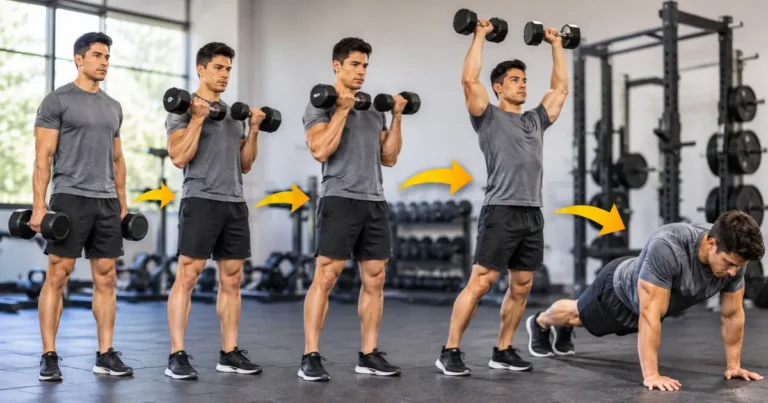
Are you lifting weights without seeing results? Stop stalling and start progressing with a science-backed workout schedule for strength that easily fits your busy week. Using 2026 ACSM and WHO guidelines, this 12-week guide covers the exact loads, sets, and rest periods needed to help you build the best workout routine for continuous muscle growth.
What a Strength Training Program Needs to Deliver Results
A strength training program delivers results when it loads all major muscle groups with high effort, at least twice a week, and raises that load gradually over time, a principle known as progressive overload. The 2026 ACSM position stand, which pooled 137 systematic reviews and more than 30,000 participants, supports this approach, and WHO asks for the same minimum. Participation is still low: about 30% of American adults meet the muscle-strengthening guideline, and 45% of EU survey respondents say they never exercise or play sport.
Neural Adaptation vs Muscle Size in Early Strength Gains
Early strength gains come mostly from your nervous system learning to use the muscle you already have, with muscle growth contributing more as the weeks pass. In the first weeks, your brain improves motor unit recruitment, which means switching on more of the nerve cells and muscle fibers that produce force, and it improves how well they work together. A motor unit is one nerve cell plus the muscle fibers it controls.
For example, you may add weight to your squat across your first month while your thighs look the same. That is normal, because muscle growth starts early but takes longer to become visible. We suggest tracking the weight you lift, not your reflection, in the early weeks.
Because so much early progress is skill, the first phase of any strength training routine should prioritize clean, repeatable technique. That is why the plan below starts with moderate loads. Practicing the main lifts at weights you can control gives your coordination time to catch up before heavier loads raise the stakes.
The Main Lifts That Anchor a Strength Workout Routine
The main lifts are the squat, bench press, deadlift, and overhead press: compound exercises that train several joints and large muscle groups at once and can be loaded in small steps. A strength workout routine built around them covers your legs, hips, chest, shoulders, and back with few exercises. This is what each lift trains most:
- Squat: thighs, hips, and trunk.
- Bench press: chest, shoulders, and the back of the upper arms (triceps).
- Deadlift: hips, hamstrings, back, and grip.
- Overhead press: shoulders, triceps, upper back, and trunk.
These lifts are practical choices, not requirements. The ACSM review found no consistent strength difference between free weights and machines, while full range of motion and placing heavy exercises early in a session each favored strength. If a barbell lift does not suit your body or your gym, a leg press, a chest press machine, or a trap bar deadlift can fill the same role, and with these choices made, the next step is arranging them into a weekly schedule.
Designing a Weekly Schedule for Strength Training
A weekly schedule for strength training answers three questions: how many days you lift, which exercises go on each day, and how much rest sits between sessions. Our aim in this workout schedule for strength is to train every major muscle group at least twice per week, the minimum that WHO and ACSM both support. Start with the number of days you can keep up through a busy month, because consistency matters more than an ambitious plan you abandon.
Choosing Two, Three or Four Strength Sessions per Week
Most healthy adults make good progress with two to four strength sessions per week. The ACSM overview found that strength improved when training frequency reached at least two sessions per week, found no clear upper limit, and noted that the benefit of frequency shrinks when total weekly volume is equal. A meta-analysis reached a similar view: extra weekly sessions mainly help by making it easier to add training volume.
An older meta-analysis suggested that beginners gained the most when they trained each muscle group three days a week, while trained lifters did best at two. Pick the row in Table 1 that matches the days you can protect in your calendar, and leave at least one rest day between sessions that load the same muscles heavily. If your week changes, move down a row instead of skipping training.
| Sessions per week | Who it suits | Example layout |
|---|
If you train at home, the ACSM review found that elastic band and home-based programs also improved strength compared with no training. Reaching very heavy loads is harder with bands, so progress by adding repetitions, sets, or band tension.
Sets, Reps and Intensity Zones for Maximal Strength
Maximal strength is built mainly with heavy loads, about 80% of your one-rep max (1RM) or more, lifted for 2 to 3 sets per exercise. In practice, that usually means low reps, about 3 to 6 per set, stopping with 2 to 3 reps still in reserve. For example, 5 reps with a weight you could lift about 8 times is a sound strength set.
Using Percentage-Based Loading From a Tested One-Rep Max
Percentage training, also called percentage-based loading, means choosing each set’s weight as a share of your 1RM, the heaviest load you can lift once with good technique. If your tested squat 1RM is 100 kg (220 lb), 80% is 80 kg (176 lb), rounded to the nearest plate you own.
If you have not tested a max, a set of 5 clean reps that leaves about 1 rep in reserve is close to 85% of it, so divide that weight by 0.85. Treat every estimate as approximate: a meta-regression of about 7,000 people found large differences between individuals and between exercises. Table 2 shows how percentages, loads, and reps relate.
| Percent of 1RM | Example load (1RM of 100 kg / 220 lb) | Approx. reps to failure | Reps in a strength set (2 to 3 in reserve) |
|---|
Rest Periods Between Heavy Sets
For heavy strength sets, resting about 2 to 5 minutes between sets is common practice, because longer rests help you keep the load on the bar from set to set. Short, heavy efforts draw on a fast energy supply made of adenosine triphosphate (ATP) and phosphocreatine, called the ATP-PC system. It refills quickly at first, with roughly half restored within 30 to 60 seconds, and then more slowly over several minutes.
The research on rest is less strict than the rule of thumb. One review found that strength still rose with rests under 60 seconds, that 60 to 120 seconds looked sufficient for beginners, and that rests above 2 minutes appeared to maximize gains in trained lifters; the 2026 ACSM overview found no consistent effect of short (under 1 minute) versus long (over 1 minute) rests on strength. For this plan, we use these rest times to protect your heavy sets:
- Weeks 1 to 4: about 2 minutes between main-lift sets.
- Weeks 5 to 8: about 3 minutes between main-lift sets.
- Weeks 9 to 12: 3 to 5 minutes, especially above 85% of 1RM.
- Accessory exercises: about 1 to 2 minutes.
A longer rest does not make a session easier; it lets you give each heavy set your full effort. We estimate that most sessions in this workout schedule for strength take about 60 to 75 minutes, including the warm-up. Next, we place the sets, reps, and rest times into a 12-week sequence.
A 12-Week Strength Building Program
A 12-week strength building program is a training block with planned changes in load, sets, and rest, so that your lifts progress in a clear order. Periodization, the planned variation of training over time, is not required: the ACSM overview found that it does not consistently change outcomes when progressive overload is used, although one meta-analysis found larger 1RM gains with periodized plans. We use three phases because they also manage fatigue and give you a clear testing date.
This workout schedule for strength uses two full-body sessions, A and B, on three days per week. In odd weeks, train A, B, A on Monday, Wednesday, and Friday, and in even weeks, train B, A, B, so that every main lift is trained three times across two weeks. Table 3 lists the strength workout exercises, and Table 4 shows how sets, loads, and rest change by phase.
| Order | Session A | Session B | How to load it |
|---|
| Weeks | Phase | Main lifts | Load | Rest |
|---|
Weeks 1 to 4: Technique and Volume Accumulation
Weeks 1 to 4 form the accumulation phase, in which you practice technique and build a base of work at moderate loads. Lighter loads are often needed while you learn the movements, and one meta-analysis found that beginners gained the most at an average intensity near 60% of 1RM, compared with about 80% for trained lifters. We use about 70% of 1RM, or a weight you could lift roughly 12 times, and follow this checklist in every session:
- Main lifts: 3 sets of 8 reps at about 70% of 1RM, leaving 3 to 4 reps in reserve.
- Accessory exercises: 2 to 3 sets of 8 to 12 reps, stopping 2 to 3 reps short of failure.
- Warm-up: 5 minutes of easy cardio, then 2 to 3 lighter ramp-up sets of your first lift.
- Rest: about 2 minutes between main-lift sets.
- Progress: add the smallest plate (1.25 to 2.5 kg, or 2.5 to 5 lb) once every set feels controlled with 3 or more reps in reserve.
- Log: write down the weight, reps, and effort of every set.
Keep your technique simple during this phase. Use a full range of motion, pause briefly on the chest in the bench press, and film one set per lift from the side to check your bar path and back position. Small corrections made now cost little, while the same errors under heavy loads in week 9 cost much more.
Weeks 5 to 8: Intensification Phase
Weeks 5 to 8 form the intensification phase, in which loads rise to about 80% of 1RM and sets drop to 5 reps. This is the zone where the ACSM overview found strength to be enhanced, at 80% of 1RM or more, with 2 to 3 sets per exercise. Before week 5, recalculate your percentages from a recent hard set or a new test, because your 1RM has probably risen, and follow this checklist:
- Main lifts: 3 sets of 5 reps at about 80% of 1RM, leaving 2 to 3 reps in reserve.
- Accessory exercises: 2 to 3 sets of 8 to 10 reps, stopping 1 to 2 reps short of failure.
- Rest: about 3 minutes between main-lift sets.
- Progress: add the smallest plate once every set is completed with 2 or more reps in reserve, and repeat the same weight if you miss reps.
If a session goes badly, do not chase the missed weight. Repeat the same load next time, and check your sleep, food, and stress before changing the plan. One slow session is common, but two or three in a row suggest that you need an easier week.
Weeks 9 to 12: Peaking and Testing New Maxes
Weeks 9 to 12 form the peaking phase, which lowers volume while loads rise so that you arrive at your test fresh. In weeks 9 and 10, perform 3 sets of 3 reps at about 85% to 88% of 1RM, then drop to 2 sets of 3 at about 80% in week 11 to recover. In week 12, test your squat, bench press, and deadlift on separate days.
How to Safely Test a New One-Rep Max
A one-rep max test is a controlled series of increasingly heavy single lifts that ends when you cannot complete another repetition with good technique. Run it only if you are comfortable with the lift and a trained spotter or safety bars are in place. If you are newer to lifting, test a 3-rep or 5-rep max and estimate your 1RM, and follow these steps:
- Rest well beforehand: no heavy work on that lift for 2 or more days, and no testing when you are ill or short of sleep.
- Set up safety: use a spotter for the bench press, and set the safety bars in the squat rack just below your lowest bar position.
- Warm up with 5 to 10 easy reps, then rest 1 minute.
- Add 5% to 10% and perform 3 to 5 reps, then rest 2 minutes.
- Add another 5% to 10% and perform 2 to 3 reps, then rest 2 to 4 minutes.
- Attempt a single lift at a near-maximal weight. After a success, rest 2 to 4 minutes and add a small amount of weight. After a miss, rest and reduce the weight by 2.5% to 5%.
- Aim to find your max within 3 to 5 attempts, and stop if your technique breaks down.
Write down the result and the date, then use the new numbers to set your percentages for the next block. If a lift felt unstable or stalled, accessory work is how you fix whatever held it back. That is the subject of the next section.
Lifting Routine for Strength: Accessory Work That Supports the Big Lifts
Accessory work is the set of lower-load exercises that strengthen the muscles or positions that limit your main lifts. A lifting routine for strength adds two to four of them per session, chosen for your weak points: a slow drive out of the bottom of a squat may point to the thighs and glutes, while a bench press that stalls halfway may point to the triceps and shoulders. Keep accessory sets 1 to 2 reps short of failure so that they do not drain the energy you need for heavy lifts.
Core and Upper-Back Work for Heavier Lifting
Core and upper-back strength help you keep a rigid, stable torso under heavy loads. Core bracing means tightening the muscles around your whole trunk at the same time, as if you were about to be nudged in the stomach. A brief breath hold, called a Valsalva maneuver, raises pressure inside the abdomen, which may add spine stability, but it also raises blood pressure for a few seconds.
If you have high blood pressure or a heart condition, ask your doctor how to breathe during heavy sets before you practice this technique. Learn the brace with an empty bar or light weights first, and add load only when it feels automatic. These steps work for the squat, deadlift, and overhead press:
- Breathe in low, so that your belly and lower ribs expand.
- Tighten your abdominal wall in all directions, without pulling your belly button inward.
- Keep that tension through the repetition, and breathe out after the hardest point or at the top.
- Reset your breath and your brace before the next repetition.
A strong upper back helps you hold the bar position in the squat, keep your shoulder blades stable in presses, and keep the bar close in the deadlift. Choose two or three exercises from the checklist below for the accessory slots in Sessions A and B.
- Core: plank, side plank, dead bug, or Pallof press, 2 to 3 sets of 20 to 40 seconds or 8 to 12 reps.
- Upper back: chest-supported row, cable row, lat pulldown, or face pull, 2 to 3 sets of 8 to 12 reps.
Progress these exercises the same way as your main lifts, by adding a little weight or a few seconds once the work feels controlled. Hard training only turns into strength if you recover from it, so the next section covers sleep, food, and injury prevention.
Recovery, Nutrition and Injury Prevention for Strength Athletes
Recovery is the time and resources your body needs to repair and adapt after training, and it is where strength is built. Adults should sleep 7 or more hours per night on a regular basis, according to the American Academy of Sleep Medicine and the Sleep Research Society, and a 2025 systematic review found that sleep loss can reduce strength performance. For protein, EFSA sets a population reference intake of 0.83 g per kg of body weight per day for adults.
People who lift often aim higher: sports nutrition guidance suggests 1.4 to 2.0 g per kg per day, and a meta-analysis found that the extra benefit for lean-mass gains levels off near 1.6 g per kg per day on average. For a 75 kg adult, 1.6 g per kg equals about 120 g of protein per day. If you have kidney disease, ask your doctor before raising your protein intake.
Strength training may also protect you from injury. A meta-analysis of 25 trials with 26,610 participants found that strength training programs were linked to sports injuries falling to less than one third of the control level, and overuse injuries almost halving. Those trials took place in sport settings, so the figures may not transfer exactly to recreational lifters, and this checklist covers the basics of recovery and risk:
- Sleep: aim for 7 or more hours on a regular schedule.
- Protein: spread your daily intake across the day, with about 20 to 40 g per meal.
- Spacing: leave at least one rest day between sessions that load the same lifts heavily.
- Warm-up: do light ramp-up sets before heavy work, since skipping a warm-up is a common cause of strains.
- Easier week: drop to 2 sets per exercise at lighter loads if your lifts slow down, your sleep worsens, or your joints ache for 2 or more sessions in a row.
When to See a Sports Physiotherapist About Lifting Pain
A sports physiotherapist (called a sports physical therapist in the United States) is a licensed clinician who assesses exercise-related muscle, tendon, and joint problems and guides your return to lifting. Muscle soreness after a hard session usually settles within a few days and is not a reason to stop training. Pain that is sharp, one-sided, or longer-lasting deserves an assessment, so book an appointment, or ask your doctor, if you notice any of these:
- Pain that lasts longer than about a week or gets worse from session to session.
- Joint pain in the knee, shoulder, elbow, hip, or spine that changes your technique or stops you from lifting.
- Pain at rest, or pain that wakes you at night.
- Swelling, bruising, or stiffness that is not settling.
- Pins and needles, numbness, or weakness in an arm or leg.
Some symptoms need urgent care instead of a routine appointment. Call your local emergency number (112 in the European Union, 999 in the United Kingdom, 911 in the United States) or go to the emergency department right away if any of these apply:
- You heard a crack or pop, the area has changed shape, or you cannot move it or put weight on it.
- Back pain comes with numbness or tingling around the genitals or anus, loss of bladder or bowel control, or pain, tingling, weakness, or numbness in both legs.
- You have chest pain, severe shortness of breath, or fainting during or after exercise.
Rules for seeing a physiotherapist without a referral differ by country and by health plan, so check locally; in many parts of the NHS, for example, you can refer yourself to a community musculoskeletal service. If you still have questions about the plan itself, the answers below cover the three most common ones.
Strength Training Program FAQs
These short answers cover three common questions about how long a strength workout program takes to work, how it differs from general lifting, and how hard to push. Each draws on the evidence used throughout this guide, and none replaces advice from a clinician who knows your health history.
How Long Does It Take to Get Noticeably Stronger?
Many beginners notice they can lift more within the first few weeks, because early gains come largely from nervous system adaptation. Clearer changes usually build across a 12-week block like the one above, and the trials in the ACSM review lasted at least 6 weeks. Progress slows with experience, so expect smaller steps in later blocks.
Is a Strength Program Different From a Weight Training Routine?
Yes, mainly in the goal and the loading. In the strength vs hypertrophy comparison, a strength program prioritizes heavy loads, about 80% of 1RM or more, in lower-rep sets. A general weight training routine spans a wider range: the ACSM overview found that muscle growth (hypertrophy) was similar across light and heavy loads when effort was high, and that it responded to higher weekly volume, about 10 or more sets per muscle group.
Should Beginners Train to Failure on Strength Days?
No, beginners do not need to train to failure on strength days, because the ACSM position stand concluded that training to failure does not improve strength compared with stopping short, and that finishing sets with about 2 to 3 reps in reserve provides enough effort. Form can also deteriorate as a set approaches failure under heavy loads, which may raise the chance of a lifting injury. Stopping short leaves you fresher for your next session.
A well-built workout schedule for strength rests on a few repeatable decisions: lift at least twice a week, use heavy loads for 2 to 3 sets, rest long enough to keep the weight on the bar, add load in small steps, and prioritize sleep and protein. The 12-week plan puts these decisions in order, and a doctor or sports physiotherapist can adapt it to your health and any pain. If you have questions about fitting this schedule into your own week, leave a comment below.