Feeling overwhelmed on your first visit? Instead of wandering between machines, start with foundational gym workout exercises designed specifically for beginners. This guide breaks down the essential movements and crucial safety habits you need to navigate a crowded floor. Learn how to structure these basics into the best workout routine to turn your initial motivation into lasting results.
Regular exercise is still out of reach for many Europeans. The 2026 Eurobarometer on sport and physical activity, which surveyed 26,508 people, found that 39% never exercise or play sport, down from 45% in 2022. Lack of time was the most common barrier at 37%, while health and fitness facilities rose from 33% to 39% as a place to exercise. A workout short enough for a lunch break speaks to that barrier.
Your First Steps on the Gym Floor
Your first steps on the gym floor are to book an induction, learn the layout, and settle on a gym routine small enough to repeat twice a week. That modest target matches the 2026 American College of Sports Medicine (ACSM) position stand, which reviewed 137 systematic reviews and found the biggest jump in results comes from moving from no resistance training to any resistance training. Starting small also keeps soreness manageable, so a second visit feels possible.
Before you start, talk to your doctor if you have a chronic condition such as heart disease, diabetes or osteoarthritis, or if you have had chest pain, dizziness or joint pain with activity. Ireland’s Health Service Executive gives this advice, and the European Society of Cardiology’s 2020 sports cardiology guidelines likewise stress individualized assessment for people with known heart disease. Once that is settled, two things make the first visits easier: a good induction and a clear map of the floor.
Getting the Most From a Gym Induction
A gym induction is a short orientation, offered by many clubs, in which a staff member shows you the equipment, the safety rules and sometimes a starter program. It works best when you arrive with questions rather than waiting to be told everything. Bring the list below, and ask the instructor to watch you repeat each movement once.
- Ask how to adjust the seat, pads and weight pin on each machine you plan to use.
- Ask where dumbbells and plates go after use, because gym etiquette varies from club to club.
- Ask which hours are quietest if crowds make you tense.
- Tell the instructor about any injury, surgery or health condition before you start.
- Ask whether a personal trainer session is available if you want a program built around your goals.
For example, if the leg press is on your list, ask the instructor to set the seat while you sit in it, then adjust it yourself once while they watch. That single run-through of the setup teaches more than a poster on the wall.
Understanding the Gym Layout: Free Weights, Machines and Cardio Zones
Most gyms divide the floor into three zones: a cardio area, a resistance machines area and a free weights area. Each zone suits a different job, and knowing which is which lets you plan a route through your workout instead of improvising between sets.
- Cardio area: Treadmills, bikes, rowers and cross-trainers. Use it for your warm-up and for finishers.
- Resistance machines: Fixed-path equipment with a weight stack and a pin. This is the easiest place to learn a movement.
- Free weights area: Dumbbells, benches and racks. Movements here ask for more balance and control, so many beginners start with dumbbells rather than barbells.
In most European clubs plates and dumbbells are marked in kilograms, while many American clubs use pounds, so check the label before you load anything (1 kg is about 2.2 lb). With the floor mapped out, the next question is which movements deserve your first few weeks.
Essential Gym Workout Exercises to Learn First
The essential gym workout exercises are the ones that train a whole movement pattern: a leg-dominant move, a push, a pull and a core brace. The World Health Organization (WHO) advises adults to do muscle-strengthening activity for all major muscle groups on at least two days a week. A 2022 meta-analysis of 16 cohort studies (Momma et al., 2022) linked 30 to 60 minutes a week to a 10 to 20 percent lower risk of death from any cause, though such observational data can’t prove cause. We chose the four patterns below as your foundational lifts.
Lower-Body Gym Exercises: Leg Press, Squat and Romanian Deadlift
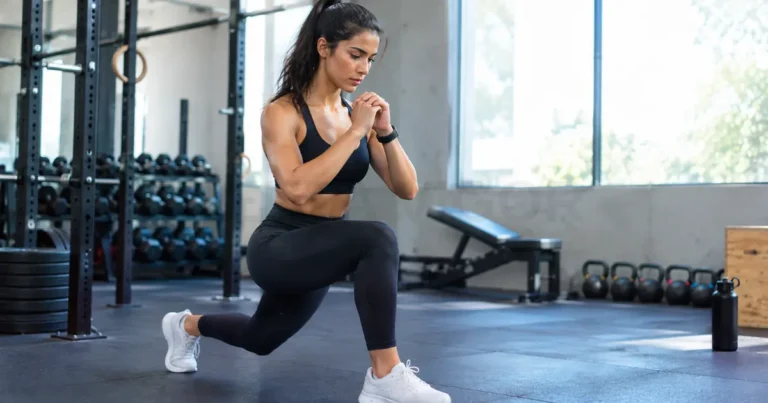
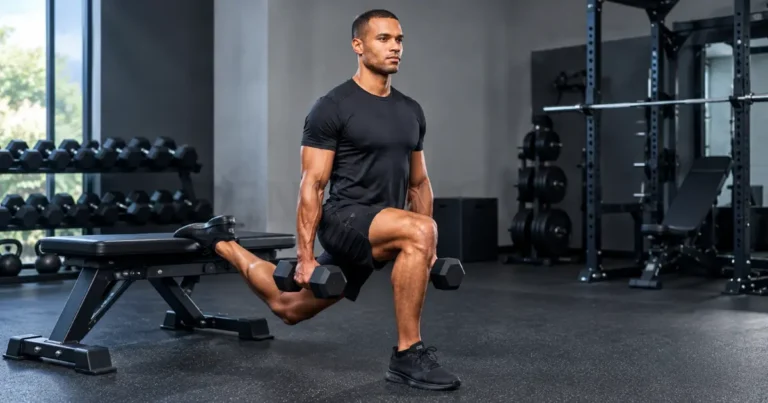
Lower-body gym exercises train the quadriceps (front of the thigh), glutes and hamstrings (back of the thigh), and three of them suit a first month: the leg press, the goblet squat and the Romanian deadlift. Each uses large muscles, so light loads already feel like work.
- Leg press: Sit with your back and hips flat on the pad and your feet shoulder-width apart, mid-platform. Lower until your knees bend to roughly 90 degrees, then press up without snapping your knees straight.
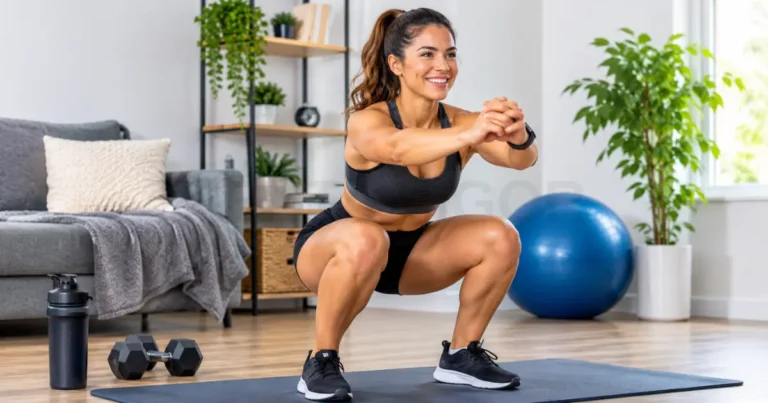
- Goblet squat: Hold one dumbbell against your chest, sit down between your knees while keeping your chest tall, then push the floor away to stand.
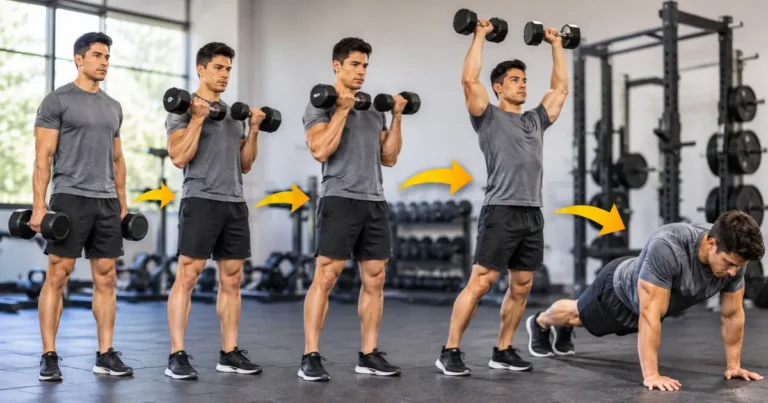
- Romanian deadlift: Hold dumbbells in front of your thighs, push your hips back with soft knees and a flat back, and lower until you feel a stretch behind your thighs. Drive your hips forward to stand.
If a squat pattern feels awkward, start with the leg press for two weeks and add the goblet squat afterward. Machines demand less technical skill, and ACSM has argued they may be safer to learn on than free weights (Haugen et al., 2023).
Upper-Body Push Exercises: Chest Press, Dumbbell Bench and Shoulder Press
Upper-body push exercises train the chest, the fronts of the shoulders and the backs of the arms (triceps) by moving weight away from your body. The chest press machine, the dumbbell bench press and the shoulder press cover the two main directions: forward and overhead.
- Chest press machine: Set the seat so the handles line up with the middle of your chest, keep your shoulder blades against the pad, and press forward without locking your elbows.
- Dumbbell bench press: Lie back with your feet flat on the floor and the dumbbells above your chest. Lower them to the sides of your chest with your elbows angled about 45 to 60 degrees from your torso, then press up.
- Shoulder press: Sit with your back supported, start with the handles or dumbbells at shoulder height, and press overhead while keeping your ribs down.
Choose light dumbbells at first. Heavy pairs are hard to get into position safely, so ask a staff member or training partner for a hand-off when you progress. Many coaches also match pressing sets with pulling sets, which the next section covers.
Upper-Body Pull Exercises: Lat Pulldown and Seated Row
Upper-body pull exercises train the large muscles of the back (the lats) and the biceps by moving weight toward your body. The lat pulldown and the seated cable row are the most beginner-friendly versions, and either belongs in a first gym workout plan.
- Lat pulldown: Sit with your thighs secured under the pad and grip the bar slightly wider than your shoulders. Pull the bar to your upper chest, leading with your elbows, and let it rise under control. Most coaches advise against pulling behind the neck because it stresses the shoulder joint.
- Seated cable row: Sit tall with a slight bend in your knees, pull the handle toward your lower ribs, and pause briefly with your shoulder blades drawn back. Avoid rocking your torso to move the weight.
If your form drops, lower the weight rather than leaning back to finish the rep. For example, if the bar lifts you off the seat or your torso swings, move the pin one or two plates lighter and repeat the set.
Core Exercises Using Gym Equipment
Core exercises train the muscles around your trunk that resist, create and control movement, and gym equipment lets you load them gradually. A cable woodchop, a hanging knee raise and an ab machine give you three different ways to do it.
- Cable woodchop: Set the pulley high, stand side-on to the stack, and pull the handle diagonally down across your body, turning from your trunk rather than your arms.
- Hanging knee raise: Hold a pull-up bar, or use a captain’s chair (a frame with back and forearm pads), and raise your knees toward your chest without swinging. Choose the captain’s chair if your grip tires first.
- Ab machine: Adjust the seat so the pivot lines up with your waist, curl forward with your abs, and return slowly.
Two sets of one core exercise are usually enough while you learn, since your trunk also works during squats, presses and rows. Pick the version that feels most stable and keep it for a month. Next, we put these movements together into three workouts you can start this week.
Sample Gym Plan: Three Workouts You Can Follow This Week
A sample gym plan for your first week uses three short gym workouts on non-consecutive days, such as Monday, Wednesday and Friday, so each muscle group gets a rest day before you train it again. If three days won’t fit your schedule, two still meet the WHO minimum for muscle-strengthening.
Every gym strength workout below starts with five minutes of easy cardio and one or two lighter practice sets of the first exercise. Across the week, this adds up to roughly four to eight sets for most major muscle groups, a deliberate starting point below the 10 weekly sets the 2026 ACSM review linked with greater muscle growth.
Gym Workout A: Full-Body Machine Circuit
Workout A is a full-body machine circuit, an easy way to start a beginner gym workout. A machine circuit means moving from one station to the next, resting about 60 to 90 seconds between sets, and completing two rounds of the list.
- Leg press: 2 sets of 10 to 12 repetitions
- Chest press machine: 2 sets of 10 to 12
- Seated row machine: 2 sets of 10 to 12
- Shoulder press machine: 2 sets of 10 to 12
- Lat pulldown: 2 sets of 10 to 12
- Ab machine: 2 sets of 12 to 15
Aim for 30 to 40 minutes including the warm-up. Pick weights that leave two to three repetitions in reserve on every set, a method explained below. The NHS suggests 8 to 12 repetitions per set, with at least two sets per exercise and a third for added benefit.
Gym Workout B: Free-Weight Foundations
Workout B swaps machines for dumbbell exercises, which ask for more balance and coordination. This free weight workout suits you once Workout A feels familiar, which takes many people a week or two. Rest about 90 seconds to two minutes between sets, although a 2017 systematic review found both shorter and longer rests workable for untrained people (Grgic et al., 2017).
- Goblet squat: 2 sets of 8 to 12 repetitions
- Dumbbell bench press: 2 sets of 8 to 12
- One-arm dumbbell row: 2 sets of 8 to 12 per side (one hand and knee on a bench, pulling the dumbbell toward your hip)
- Romanian deadlift: 2 sets of 8 to 12
- Seated dumbbell shoulder press: 2 sets of 8 to 12
- Cable woodchop: 2 sets of 10 per side
Start with dumbbells that feel almost too light. Learn the pattern with a weight that lets you finish 10 repetitions with two or three to spare, then move up in the smallest jumps your rack allows. For example, going from 6 kg to 8 kg (about 13 lb to 18 lb) is a sensible step.
Gym Workout C: Strength Plus Cardio Finisher
Workout C pairs a shorter strength block with a cardio finisher. Do the leg press, shoulder press and lat pulldown for two sets each, then finish with 10 minutes of cardio at a pace where you can talk but not sing, a common check for moderate intensity. This light conditioning counts toward the 150 to 300 weekly minutes of moderate aerobic activity that the WHO recommends for adults.
Choosing Weights for Your First Gym Session
Choose a starting weight that lets you finish each set with two to three repetitions still in the tank, a measure called repetitions in reserve (RIR). Many lifters pair it with a rating of perceived exertion (RPE) from 1 to 10, where an RPE of 7 roughly equals three repetitions in reserve (Zourdos et al., 2016).
- Pick a weight that feels light and complete 10 slow repetitions.
- If the set felt easy enough for four or more extra repetitions, add the smallest increment next time.
- Record the weight and repetitions so your next session has a starting point.
Beginners often misjudge how close they are to failure, and those guesses improve with training experience (Steele et al., 2017), so err on the light side at first. Once your starting weights are set, the next section covers sharing the floor well and knowing what to do when something feels wrong.
Gym Etiquette and Safety on a Busy Gym Floor
Gym etiquette is the set of shared habits that keep a crowded floor safe and usable, and most of it comes down to re-racking weights and leaving equipment as you found it. It also protects you, since stray plates and dumbbells on the floor are tripping hazards.
- Re-rack weights after every set you finish, so the next person can start without a clean-up.
- Wipe the bench or seat after you use it.
- Ask someone using a machine how many sets they have left, and offer to alternate between sets.
- Keep your bag and bottle away from walkways and equipment.
- Give people space during their sets, and ask before using equipment they have set up.
Safety also means knowing when to stop, and no workout is worth ignoring a warning sign. Stop the session and seek urgent medical help if you notice any of these, calling your local emergency number (112 across the EU, 911 in the United States) when symptoms are severe:
- Chest pain, pressure or tightness
- Severe shortness of breath that doesn’t ease with rest
- Fainting, near-fainting or sudden severe dizziness
- A racing or irregular heartbeat that doesn’t settle
- Severe muscle pain with swelling, weakness or dark, tea-colored urine, which can signal exertional rhabdomyolysis, a serious muscle breakdown that can harm the kidneys (Stony Brook Medicine)
Ordinary muscle soreness usually peaks one to three days after a workout and eases gradually, with no dark urine or marked weakness. Sharp joint pain during a movement is a separate signal: stop that exercise and ask a doctor or physical therapist if it persists.
Using Machines Correctly: Seat Height and Range of Motion
Using a machine correctly means adjusting it to your body before the first repetition, so the pivot lines up with the joint that moves. Machines guide the path of each repetition, which makes workouts in the gym easier to start, yet only when the setup fits you. The 2026 ACSM review also found that strength gains were enhanced by training through a complete range of motion.
- Read the diagram on the machine, which usually shows the correct machine setup and the muscles it works.
- Set the seat so the joint you are moving lines up with the pivot point, for example your knee beside the axis on a leg extension.
- Adjust pads and handles so they touch your body snugly without squeezing.
- Put the pin in a light plate and complete two slow test repetitions.
- Move through the largest range that stays pain-free, and lower the weight slowly instead of letting the stack drop.
- Note your seat and pad numbers so you can reset them next visit.
If a position pinches your shoulder, hip or knee, shorten the movement and ask a staff member to check the setup before you add weight. Sharp pain is a reason to stop, while a muscle burn that fades after the set is normal effort.
Knowing When You Need a Spotter or Safety Pins
You need a spotter or safety pins whenever a failed repetition could trap the bar over your face, neck or back, which includes the barbell bench press and the barbell squat. A spotter is a person who stands ready to help you finish or rack the weight, and safety pins are adjustable steel bars in a power rack that catch the barbell if you can’t lift it.
- Set the safety pins just below the lowest point the bar reaches, and check that both sides match (Haff and Triplett, 2016).
- Tell your spotter how many repetitions you plan and when you want help.
- Don’t ask a stranger for a heavy spot without agreeing on a plan; ask staff if you’re unsure.
- Re-rack the bar and clear the plates before you leave the station.
At the light loads used in this plan, machines, dumbbells and cables rarely need a spotter, since you can stop and set the weight down. Barbell lifts can wait until a trainer has checked your technique. Next, we answer the three questions beginners ask most.
Gym Workout Plan FAQs
These short answers cover the three questions beginners ask most about a workout in a gym, from session length and equipment choice to nerves. Each answer draws on published guidance or research and points back to the workout exercises at the gym covered above.
How Long Should a Gym Session Last?
Gym session length for beginners usually falls between 30 and 60 minutes, warm-up included. Workouts A and B above fit in roughly 30 to 40 minutes. The 2026 ACSM position stand points out that the biggest gain comes from doing any resistance training, so a short session you repeat beats a long one you skip. Stop when your form starts to slip.
Should You Use Machines or Free Weights as a Beginner?
Either works, so choose the one you will actually use. A 2023 meta-analysis of 13 trials and 1,016 participants found no meaningful differences in direct comparisons of strength, jump height or muscle growth between free-weight and machine training (Haugen et al., 2023). The 2026 ACSM position stand reached a similar conclusion about equipment type. Strength does tend to be specific to the exercise you practice, so mix both over time.
How Do You Avoid Gym Anxiety in Your First Month?
Gym anxiety, sometimes called gymtimidation, usually eases when you shrink the goal for your first workout in a gym, visit at a quiet hour and remember that most people are focused on their own sets. Psychologists call the tendency to overestimate how much others notice us the spotlight effect (Gilovich et al., 2000). A 2023 survey by UK gym chain Fitness First reported that 39% of adults avoid the gym because they feel self-conscious about their appearance. If dread about training is intense or spreads into daily life, talk with your doctor or a mental health professional.
Starting with gym workout exercises you understand makes the first month easier. Learn the four patterns (lower body, push, pull and core), follow the three-workout sample plan, choose weights that leave a few repetitions in reserve, and use the safety habits above on a busy floor. If you have questions about any movement, leave a comment below, and ask your gym’s staff to watch your form in person.